

The Language of the CPTED Movement
By Joelle Hushen – President and CEO

Why Language Matters
Movements rarely begin with a formal announcement. More often, they take shape gradually as conversations across professions begin to align.
Over the past several years, discussions about safety in the built environment have been expanding in this way. Planners are exploring how design influences activity and belonging. Law enforcement professionals are working more closely with community partners. Architects and developers are paying closer attention to visibility, access, and how people experience a place. Security professionals and technology providers are also recognizing how environmental design influences the effectiveness of safety strategies.
These conversations are emerging in different fields, but they are increasingly pointing in the same direction.
As that alignment grows, something else begins to emerge alongside it, a shared language.
Language plays an important role in shaping how ideas move from discussion into practice. When people across disciplines begin using similar terms to describe the same goals, collaboration becomes easier and progress becomes more coordinated.
Across the CPTED Movement series, several ideas have quietly begun forming the vocabulary that connects these conversations.
“Movements grow when people begin speaking about ideas in the same way.”
A Shared Framework
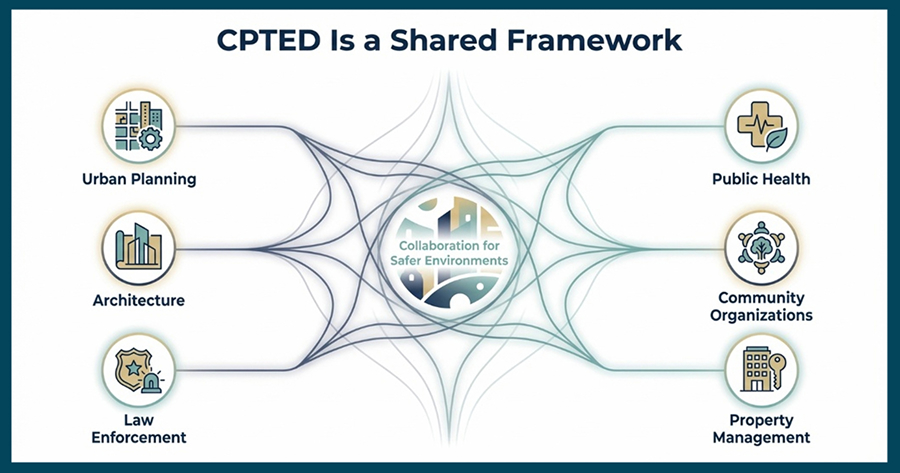
One of the phrases that appears frequently in discussions about CPTED is the idea of a shared framework.
Many professions influence how environments function. Planners shape long-term development patterns. Architects and designers determine how spaces are organized. Public safety and security professionals study patterns of activity, risk, and protective strategies. Property managers and community leaders influence how spaces are maintained and used.
When these groups approach safety using different assumptions or terminology, collaboration becomes difficult.
A shared framework helps align those perspectives.
Crime Prevention Through Environmental Design provides that structure through a set of principles that remain consistent across disciplines:
• Natural Surveillance
• Natural Access Control
• Territorial Reinforcement
• Maintenance
These principles do not belong to a single profession. They provide a practical foundation that allows different professionals to discuss safety using common reference points.
Rather than competing approaches, they help create alignment.
“CPTED provides a shared framework that allows professionals across disciplines to discuss safety using common reference points.”
Shared Responsibility
Another phrase that appears frequently in conversations about CPTED is shared responsibility.
Safety in a community is rarely the result of one profession acting alone. It emerges from the interaction between design, management, and community participation.
Lighting influences visibility.
Design shapes how spaces are used.
Maintenance communicates ownership and care.
But these elements are most effective when the people who live, work, and move through these environments understand how they contribute to their function.
“When communities understand how environments influence behavior, safety becomes something people participate in rather than something delivered to them.”
CPTED supports that understanding by helping people recognize how everyday decisions about design, maintenance, and activity shape the places they care about.
Visibility, Activity, and Ownership
While CPTED principles often appear in professional literature as technical concepts, they translate in practice into simple human experiences.
People respond to environments where they can see and be seen.
They feel comfortable in places where positive activity is present.
They develop connection to spaces that show signs of ownership and care.
Visibility encourages natural observation.
Positive activity supports legitimate use of space.
Ownership reinforces stewardship and long-term maintenance.
Together, these elements influence how environments function over time. When they are present, spaces tend to feel active, understood, and supported by the people who use them.
The Human Experience of Place
One of the ideas receiving increasing attention in CPTED discussions is the human experience of place.
Before people analyze a space intellectually, they experience it physically and emotionally.
They notice whether sightlines are clear.
They observe whether others are present and engaged.
They sense whether a place feels maintained and respected.
These signals influence how people move through environments, how long they stay, and whether they feel comfortable participating in a space.
This perspective aligns with what we have described as Embodied CPTED, the understanding that environments are experienced first through the body and senses before they are interpreted through analysis.
Design influences those experiences in ways that are immediate and intuitive.
Community Is Where Humans Connect
Another idea emerging clearly within the CPTED Movement is the recognition that community is not limited to geography.
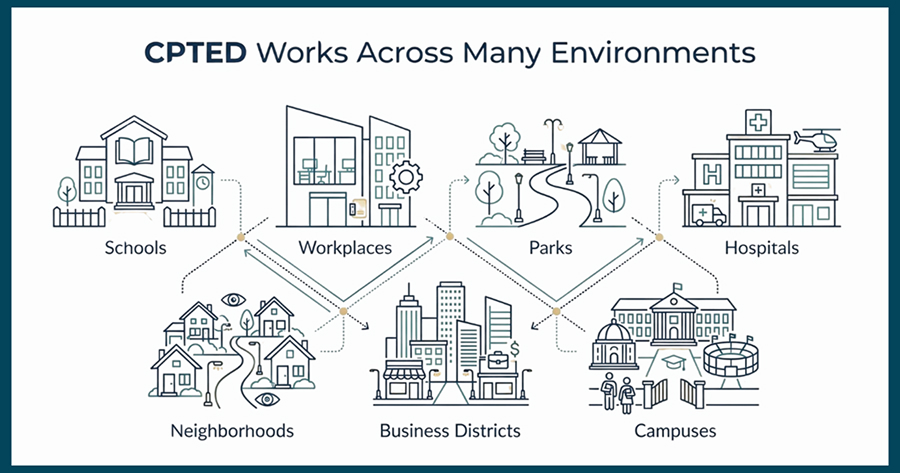
It may appear in neighborhoods, schools, workplaces, campuses, hospitals, houses of worship, business districts, or public spaces. Wherever people gather, the design and management of those environments influence how connection happens.
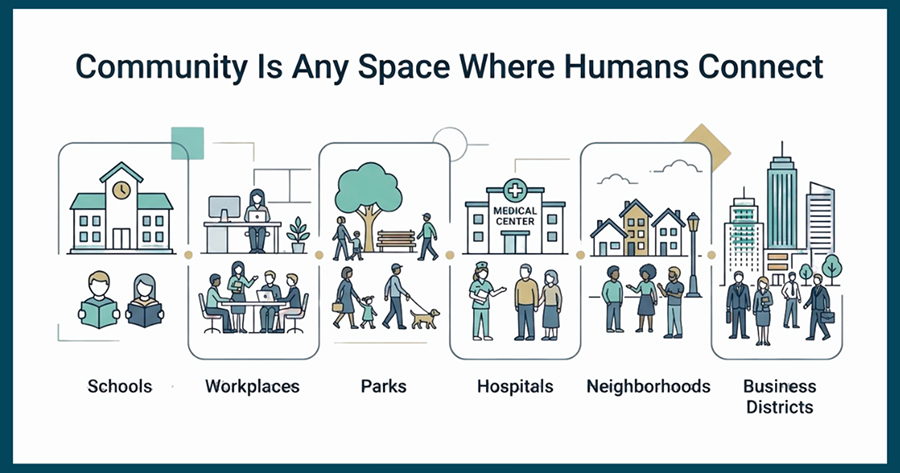
Understanding community in this broader way expands the relevance of CPTED. The principles apply not only to residential areas but to many types of environments where people interact.
A Language That Supports Collaboration
Movements grow when ideas become understandable and repeatable.
The phrases emerging across the CPTED Movement series are not intended to redefine CPTED. Instead, they help translate its principles into language that professionals and communities can share.
A shared framework helps align disciplines.
Shared responsibility encourages participation across communities.
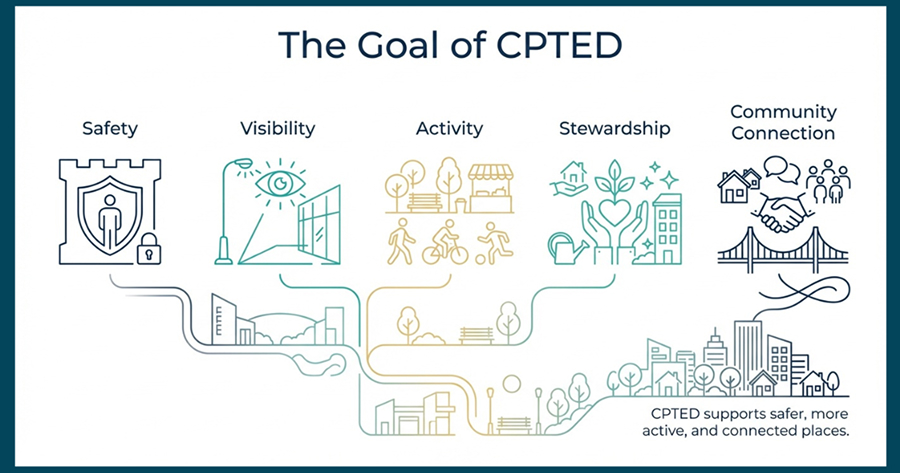
Visibility, activity, and ownership translate design principles into everyday experience.
The human experience of place reminds us that environments shape how people feel and behave.
And the understanding that community is any space where humans connect expands the conversation about where CPTED can be applied.
Together, these ideas form a vocabulary that helps people discuss safety, design, and community more clearly.
Looking Forward
Across many professions, expectations around safety are evolving.
Safety is no longer treated as a stand-alone concern. It is becoming a shared expectation, connected to public health, economic vitality, design, and community well-being.
As these conversations continue to grow, the language people use will play an important role in shaping collaboration and understanding.
CPTED provides a foundation for those conversations.
And the shared vocabulary emerging around it is helping that foundation become more widely understood across the communities and professions that influence how places function.

Joelle Hushen – President and CEO
Joelle Hushen is the Founder and President of the National Institute of Crime Prevention (NICP), Inc., an internationally recognized leader in Crime Prevention Through Environmental Design (CPTED) training and certification. Under her leadership, NICP has trained thousands of practitioners across law enforcement, planning, design, security, corporate, healthcare, and community development sectors, advancing CPTED as a practical, principle-based approach to creating safer environments. She has guided the development of NICP’s curriculum, assessment standards, and the CPTED Professional Designation (CPD), one of the most widely recognized CPTED credentials in the United States and internationally.
Joelle is also the Co-Founder and Director of the U.S. CPTED Association (USCA), where she supports national collaboration, professional development, and industry advancement. Her work focuses on the relationship between environment, behavior, and human experience, including the development of frameworks such as Embodied CPTED™ and Design for Decommission™. She is committed to expanding CPTED education and supporting professionals working to create safer, stronger communities.
Ready to Earn Your CPTED Certification?
Take the next step toward becoming a CPTED professional. Our in-person and online training options will prepare you to assess environments, apply proven CPTED strategies, and earn your CPD designation. Learn how to design safer, more livable spaces that strengthen communities and reduce crime before it happens.