

CPTED Over Time: Designing Safety for Change, Not Permanence
By Joelle Hushen – President and CEO
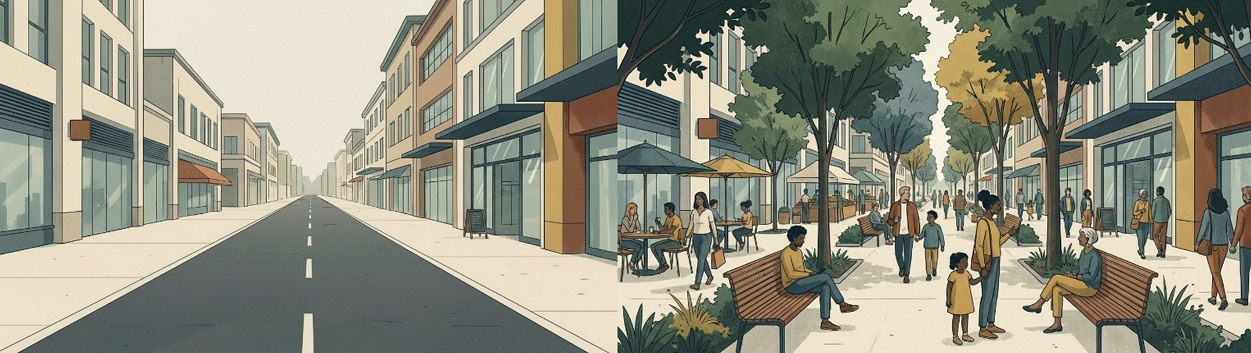
Most places are designed as if they will always function exactly as intended.
A park is planned for daily use.
A building is designed for a specific purpose.
A campus, corridor, or public space is imagined at its best moment — active, funded, and well maintained.
But real places don’t stay still.
They age.
They shift uses.
They experience periods of decline and renewal.
They absorb social, economic, and cultural change.
And when safety is treated as a one-time design decision rather than an ongoing responsibility, it becomes fragile.
CPTED was never meant to work that way.
Time Is the Missing Dimension
Crime Prevention Through Environmental Design has always focused on how environments shape behavior. But one of the most common gaps in how CPTED is applied is time.
We often ask:
• Does this design support visibility?
• Does it guide movement?
• Does it create a sense of ownership?
• Does it communicate care?
What we ask less often is:
• How will this space function five, ten, or twenty years from now?
• What happens when use changes?
• What happens when funding shrinks?
• What happens when a space becomes underused, repurposed, or temporarily vacant?
CPTED doesn’t stop being relevant when those things happen.
Static thinking does.
From Movement to Responsibility
As the CPTED movement expands beyond law enforcement and into design, planning, public health, and community development, a deeper responsibility comes into focus.
If safety is a shared practice — not something done to people — then responsibility doesn’t end at ribbon cutting.
Ownership is not a moment.
Stewardship is not a phase.
Care does not expire when a project is completed.
CPTED over time is the recognition that safety must be supported across the full lifecycle of a place — not just its opening chapter.
What CPTED Over Time Really Means
CPTED over time is not a new “generation” of CPTED.
It is not an add-on or an advanced version.
It is simply CPTED taken seriously.
It acknowledges that:
• Design choices age
• Behavioral patterns shift
• Communities evolve
• Maintenance ebbs and flows
• Uses change — sometimes by necessity
Applying CPTED over time means planning for reassessment, adaptation, and transition rather than assuming permanence.
It asks not just “Does this work now?”
But “How will this work as conditions change?”
Design for Decommission as One Moment in Time
This is where Design for Decommission fits — not as a standalone idea, but as one expression of CPTED over time.
Some places are not meant to last forever in their original form:
• Infrastructure reaches the end of its lifecycle
• Facilities outlive their original purpose
• Temporary uses become semi-permanent
• Economic or environmental conditions shift
Design for Decommission asks what happens next — and how safety, clarity, and care are maintained during transition.
But decommissioning is not the only moment CPTED must address.
CPTED over time also includes:
• Adaptive reuse
• Periods of underuse
• Seasonal activity changes
• Interim uses
• Phased redevelopment
• Long-term maintenance planning
In every case, the question is the same:
How do people experience this place now — and how will they experience it as it changes?
Change Does Not Have to Create Fear
One of the most important insights CPTED over time offers is emotional, not technical.
When communities expect places to remain frozen in their original condition, change feels like failure. It triggers fear, blame, and withdrawal.
When communities understand that change is part of a place’s lifecycle:
• Fear decreases
• Agency increases
• Stewardship becomes proactive rather than reactive
People are less likely to disengage when they understand what’s happening and why.
CPTED over time reframes change as a phase — not a loss.
Stewardship Is a Long Conversation
CPTED has always emphasized ownership, visibility, care, and natural behavior. Over time, those principles don’t disappear — they deepen.
Maintenance becomes communication.
Adaptation becomes responsibility.
Reassessment becomes normal.
CPTED over time treats safety as a long conversation between people and place — one that continues as conditions evolve.
It does not seek to preserve places at their peak moment.
It seeks to preserve clarity, legitimacy, and care across change.
Where the Movement Is Going
As safety becomes a demand — and increasingly a requirement — CPTED over time will matter more, not less.
Communities are no longer just asking:
• Is this place safe today?
They are asking:
• Will this place remain safe as it changes?
• Will people still feel ownership if its purpose shifts?
• Will design support care even during transition?
These are CPTED questions — applied across time.
And they point toward a future where safety is not designed once but sustained over time.
CPTED over time is not about holding places still.
It is about giving communities the tools to care for them — through change, transition, and renewal.

Joelle Hushen – President and CEO
Joelle Hushen is the Founder and President of the National Institute of Crime Prevention (NICP), Inc., an internationally recognized leader in Crime Prevention Through Environmental Design (CPTED) training and certification. Under her leadership, NICP has trained thousands of practitioners across law enforcement, planning, design, security, corporate, healthcare, and community development sectors, advancing CPTED as a practical, principle-based approach to creating safer environments. She has guided the development of NICP’s curriculum, assessment standards, and the CPTED Professional Designation (CPD), one of the most widely recognized CPTED credentials in the United States and internationally.
Joelle is also the Co-Founder and Director of the U.S. CPTED Association (USCA), where she supports national collaboration, professional development, and industry advancement. Her work focuses on the relationship between environment, behavior, and human experience, including the development of frameworks such as Embodied CPTED™ and Design for Decommission™. She is committed to expanding CPTED education and supporting professionals working to create safer, stronger communities.
Ready to Earn Your CPTED Certification?
Take the next step toward becoming a CPTED professional. Our in-person and online training options will prepare you to assess environments, apply proven CPTED strategies, and earn your CPD designation. Learn how to design safer, more livable spaces that strengthen communities and reduce crime before it happens.