
From Main Street to Everyday Street: Denver’s 16th Street and CPTED Over Time
By Joelle Hushen – President and CEO
For decades, downtown streets across the United States were designed for a single purpose: workday efficiency. Office towers emptied at night. Retail followed the clock. Public space was something people passed through, not something they stayed in.
When those conditions changed — through economic shifts, remote work, or the shock of the pandemic — many of those places struggled. Streets built for one use found themselves without an audience. What followed, in many cities, was a familiar pattern: concern about safety, calls for enforcement, and debates over how to “bring people back.”
Denver’s 16th Street offers a different way to understand that moment — not as a failure of design, but as a test of whether a place could evolve.
A Street Designed for a Moment — Then Asked to Adapt
For years, 16th Street functioned as a central business corridor. Its design reflected that reality: heavy daytime use, predictable flows, and a rhythm tied closely to office life.
When those conditions shifted, the street didn’t suddenly become unsafe. It became misaligned.
That distinction matters.
CPTED is often treated as something that must be added when conditions deteriorate. But in reality, many challenges emerge not from neglect or crime, but from places being asked to serve a different purpose than they were originally designed for.
Denver recognized this — and responded accordingly.
Planning for Change, Not Just Activation
Over more than a decade, Gehl partnered with the City and County of Denver and the Downtown Denver Partnership to study how people actually used the street — and how they could use it in the future.
Rather than rushing toward a single fix, the approach unfolded over time:
• Early observation and evaluation
• Pilot projects like Meet in the Street
• Incremental testing of new uses and configurations
• Long-term reinvestment once patterns became clear
This wasn’t about filling a space quickly. It was about understanding how a street could support everyday life — not just office life.
That patience is itself a form of CPTED.
Wayfinding as Stewardship Over Time
One of the quieter but most important elements of Denver’s 16th Street reinvestment is the emphasis on wayfinding and ease of movement.
As the corridor shifted from a primarily workday destination to a mixed-use, everyday street, legibility became essential. Clear routes, frequent transit stops, and intuitive connections reduced friction for residents, visitors, and workers alike. People didn’t need to be told how to use the space — they could understand it.
From a CPTED perspective, this matters over time. Wayfinding supports confident movement, reduces uncertainty, and encourages people to stay, explore, and return. It helps a place remain usable even as users change.
Rather than relying on enforcement to manage activity, Denver invested in clarity — allowing the street to function as a shared system rather than a controlled corridor.

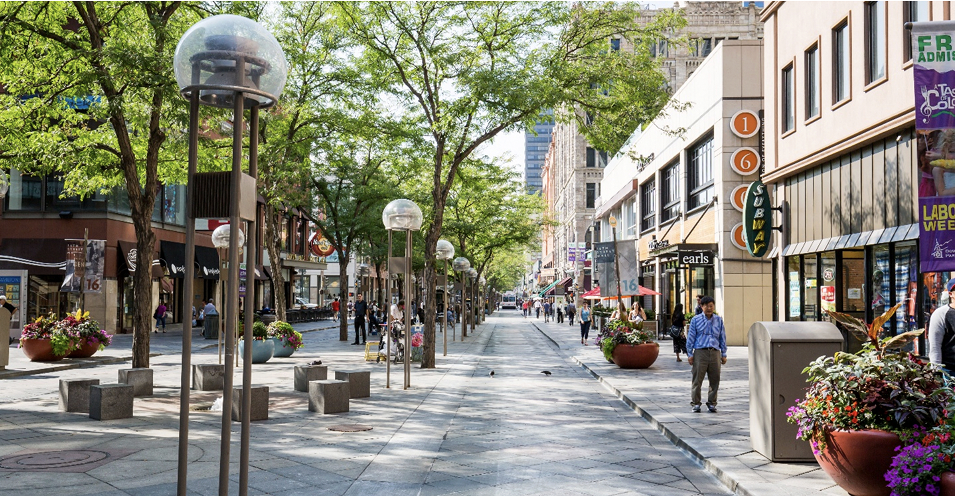
Wayfinding, transit, and everyday movement help public spaces remain legible and usable over time.
Safety as a Byproduct of Belonging
As the street shifted from a central business district corridor toward a mixed-use, everyday environment, something important happened.
Safety followed use.
Not because of increased enforcement.
Not because of heightened surveillance.
But because the street became legible, active, and socially anchored across different times of day.
Parents pushing strollers.
Residents lingering.
Visitors stopping, sitting, watching.
Local businesses regaining rhythm.
These are not decorative details. They are the informal systems that sustain public space over time.
In CPTED terms, this is natural surveillance, territorial reinforcement, and social management working together — not as a checklist, but as a living process.
CPTED Over Time, in Practice
Denver’s 16th Street illustrates what CPTED over time actually looks like:
• Design that anticipates change rather than resisting it
• Public investment aligned with human behavior, not fear
• Stewardship that continues after construction ends
• A willingness to let a place pause, adjust, and reemerge
The street didn’t need to be “fixed.”
It needed to be allowed to evolve.
That evolution required design, yes — but also observation, trust, and sustained care.
From Corridor to Community Space
What makes this story especially relevant now is that Denver’s experience is not unique.
Many downtowns are undergoing similar transitions. The lesson from 16th Street isn’t that there is a single right design solution — it’s that safety and vitality are not static outcomes.
They are conditions that must be supported over time.
CPTED, when understood as a movement and not a moment, provides the framework for doing exactly that.
When places are allowed to evolve with the people who use them, safety becomes part of everyday life — not something added in response to change.

Joelle Hushen – President and CEO
Joelle Hushen, as the Executive Director of the NICP, Inc., is responsible for course curriculum, standards, and evaluation. This includes the development and maintenance of the NICP’s CPTED Professional Designation (CPD) program, which has become the recognized standard for CPTED professionals. As part of the CPD program Joelle designed the CPTED Review, Exam, & Assessment Course and is the lead instructor.
Joelle has a background in education and research with a Bachelor of Science degree from the University of South Florida. She has completed the Basic, Advanced, and Specialized CPTED topics, and holds the NICP, Inc.’s CPTED Professional Designation. Joelle is a member of the University of South Florida Chapter of the National Academy of Inventors, and the Florida Design Out Crime Association (FLDOCA).
Ready to Earn Your CPTED Certification?
Take the next step toward becoming a CPTED professional. Our in-person and online training options will prepare you to assess environments, apply proven CPTED strategies, and earn your CPD designation. Learn how to design safer, more livable spaces that strengthen communities and reduce crime before it happens.