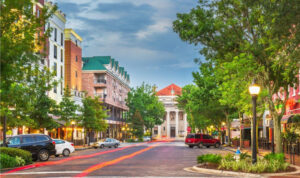

CPTED in Residential Neighborhoods: How Design Shapes Safer Communities
By Kipp Lowry, COO, CPD

What actually makes a neighborhood feel safe?
When people talk about a safe neighborhood, they rarely mention design or how the environment is structured. Instead, they describe how it feels. They talk about seeing neighbors outside, homes that look cared for, and streets that feel open and visible. What they are really describing is design.
Residential neighborhoods are one of the most important environments where CPTED can be applied because they are where routines are built and where behavior becomes predictable. That predictability is exactly what creates opportunity for crime. CPTED works by reshaping that environment in subtle but meaningful ways. It increases perceived risk, reduces opportunity, and improves the overall quality of life at the same time.
Why do residential neighborhoods matter so much in CPTED?
A neighborhood is not just a collection of homes. It is a system made up of streets, sidewalks, shared spaces, and the transitions between public, semi public, and private areas. Every part of that system communicates something, whether it is intentional or not.
Some neighborhoods naturally discourage crime because they are easy to understand and easy to observe. Others unintentionally create confusion, blind spots, and opportunities. The difference usually comes down to four core CPTED principles, which are natural surveillance, natural access control, territorial reinforcement, and maintenance. These principles are not separate ideas. They work together to shape behavior and influence how both residents and offenders interact with the space.
How does natural surveillance influence behavior?
Natural surveillance is one of the simplest ideas in CPTED, but it is also one of the most effective. When people can see what is happening around them, behavior changes. Visibility increases accountability. The more open and observable a space is, the less attractive it becomes to someone looking to take advantage of it.
In residential neighborhoods, this often comes down to how homes and spaces are positioned. Windows that face the street, front porches that encourage activity, and lighting that allows people to see at night all contribute to this effect. At the same time, things like overgrown landscaping or poorly placed fencing can interrupt visibility and create areas where people feel hidden. The difference between a well observed street and one filled with blind spots is immediate. Residents feel it, and offenders recognize it just as quickly.
What does natural access control really look like in a neighborhood?
Natural access control is often misunderstood because people associate it with gates or barriers. In reality, the most effective form of control in residential neighborhoods is much more subtle. It is about guiding movement rather than restricting it.
A well designed neighborhood makes it clear where people should go and where they should not. Sidewalks lead to entrances, pathways connect spaces logically, and the layout of streets discourages unnecessary traffic. When entry points are defined and movement feels intentional, it reduces confusion and limits opportunity.
The goal is not to create a closed off environment. It is to create one that feels structured. When movement is predictable, it becomes easier for residents to recognize when something is out of place. That alone increases perceived risk and makes the area less attractive to someone looking for an easy opportunity.
Why is territorial reinforcement so important in residential areas?
Territorial reinforcement is what gives a neighborhood a sense of ownership. When a space feels like it belongs to someone, it changes how people treat it. More importantly, it changes how people respond when something does not belong.
This sense of ownership can be created through simple design choices. Defined front yards, subtle changes in landscaping, and clear transitions between public, semi public and private space all contribute to it. The goal is not to create barriers, but to create clarity.
When people feel a sense of ownership over their environment, they are more likely to notice unusual behavior and take responsibility for what happens in that space. Without that sense of ownership, areas tend to feel anonymous, and when a space feels anonymous, no one takes responsibility for it.
How does maintenance impact crime in a neighborhood?
Maintenance is often the difference between a neighborhood that feels stable and one that feels like it is declining. It sends a constant message about whether a space is cared for or ignored.
When properties are maintained, landscaping is kept up, and issues are addressed quickly, it communicates that people are paying attention. On the other hand, things like graffiti, broken features, or neglected properties suggest that no one is watching and no one is responsible.
Maintenance supports every other CPTED principle. It keeps sightlines clear, reinforces boundaries, and preserves the structure of access points. When maintenance is consistent, the environment continues to function the way it was intended.
How do all four CPTED principles work together?
CPTED becomes most effective when all four principles are working together. Natural surveillance increases visibility, natural access control guides movement, territorial reinforcement creates ownership, and maintenance sustains everything over time.
When these elements are aligned, the environment begins to regulate behavior on its own. It becomes more difficult for someone to find an opportunity without being seen, questioned, or noticed. This is what makes CPTED so effective in residential neighborhoods. It does not rely on constant enforcement. It relies on the design of the space itself.
What are common problems found in residential neighborhoods?
Most issues found in neighborhoods are not random. They tend to follow patterns that can be identified and addressed. Poor lighting, hidden pathways, undefined shared spaces, and neglected properties all create opportunities for unwanted behavior.
CPTED provides a structured way to identify these problems by focusing on how spaces are actually used. This includes observing patterns, understanding how people move through an area, and identifying where design is creating confusion or vulnerability. Once those issues are identified, the solutions are often straightforward and focused on improving how the space functions rather than completely redesigning it.
Can design really reduce crime in neighborhoods?
CPTED is based on the idea that offenders make decisions based on risk and opportunity. If a space increases the risk of being seen and reduces the opportunity to act, behavior changes.
This does not mean crime disappears entirely, but it does mean it becomes more difficult, less predictable, and less appealing. In many cases, that shift is enough to significantly reduce incidents and improve how safe people feel in their own neighborhood.
What does a well designed neighborhood actually feel like?
A neighborhood that applies CPTED well does not feel overly controlled or restricted. It feels natural. People are outside, spaces are clearly defined, and everything looks like it is cared for.
The difference is not always obvious at first glance, but it is noticeable. The environment feels active, visible, and understood. That clarity is what makes it effective.
Where should you start?
The best way to begin applying CPTED is to walk through a neighborhood and pay attention. Look at what can be seen, how people move, where spaces feel defined, and where they do not. These observations will quickly highlight where improvements can be made.
CPTED does not require a complete redesign. Most improvements are small, practical changes that improve how a space functions and how people interact with it.
Earn Your CPTED Professional Designation
Learn how to apply CPTED principles in residential neighborhoods to improve visibility, guide movement, and strengthen a sense of ownership. Our online and in person training programs give you the practical skills to assess environments and design safer communities with confidence.