
Cities After Dark: Designing Safety for the People Who Don’t Go Home at 5 PM
By Joelle Hushen – President and CEO

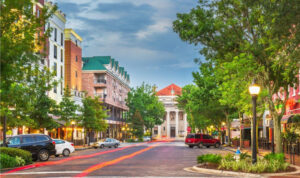
A city designed to function after dark: active streets, visible storefronts, connected transit, and public spaces that remain welcoming into the evening. When night-time environments are planned with intention, safety, economic vitality, and community life reinforce one another.
Why night-time safety, economic vitality, and community life depend on cities designed to function after dark
At 10:30 p.m., a nurse finishes a twelve-hour shift and walks toward a dimly lit parking garage.
Two blocks away, a dishwasher locks up after closing, waiting for a late bus that may or may not arrive.
Across town, a small theater lets out, patrons spilling onto a quiet street lined with blank storefronts and darkened windows.
Cities rarely picture these moments when they talk about safety.
During the day, we design for people — pedestrians, workers, families, customers.
At night, we design for property.
Lighting increases. Enforcement becomes more visible. Doors close. Spaces empty out. The city quietly shifts from supporting human experience to protecting assets. Yet cities do not shut down at sunset. They change. And for millions of people, that change defines their workday, their commute, and their quality of life.
When cities fail to plan for these realities, the result isn’t just a safety concern — it’s an economic and community development problem hiding in plain sight.
Who Cities Are Designed For — and Who They Forget
Most urban systems still operate on a daytime bias. Safety audits are conducted at noon. Public engagement assumes nine-to-five schedules. Planning conversations center on lunchtime foot traffic and weekday commuters.
Nighttime is treated as an exception — a condition to be controlled rather than designed for.
But after dark, cities are still alive. Hospital corridors hum. Restaurants close in staggered waves. Transit workers, custodians, delivery drivers, artists, and performers move through public space long after offices shut down.
When safety strategies focus only on reducing risk — closing spaces early, over-lighting without intention, restricting access — cities unintentionally communicate that nighttime users are an afterthought. The result is not increased safety, but withdrawal: fewer people, fewer eyes on the street, and fewer reasons to stay.
The Night-Time Workforce Is Economic Infrastructure
Municipal leaders across the country are grappling with workforce shortages, downtown recovery, and small business retention. Yet one critical factor is often missing from those conversations: people cannot sustain jobs in places where they don’t feel safe getting to work, being at work, or getting home.
For night-shift workers, safety is rarely about what happens inside the workplace. It’s about the spaces in between — the walk to the bus stop, the wait on a quiet platform, the final few blocks home after midnight.
Minneapolis offers a simple but telling example. Through Metro Transit’s Request-a-Stop program, bus riders traveling at night can ask to be dropped off closer to their destination, rather than at fixed stops. The policy reduces long, isolated walks, increases riders’ sense of control, and acknowledges a basic truth: movement after dark carries different risks than movement at noon.
The change required no new infrastructure and no dramatic rebranding. It was communicated as a service improvement — one designed around how people actually experience the city at night.
That kind of adjustment matters. When workers feel safer getting home, night shifts become more viable. Businesses can staff later hours. Hospitals, restaurants, cultural venues, and essential services retain employees who might otherwise leave. In this context, supporting night-time mobility is not a transportation issue alone — it is a workforce stability strategy.

Night-time transit designed with people in mind: a bus stop that is well-lit, visible, and active, allowing riders to be picked up and dropped off closer to home. Programs like Minneapolis’s late-night Request-a-Stop initiative demonstrate how small operational changes can significantly improve safety, accessibility, and workforce retention after dark.
Consider what happens when night environments are designed poorly:
• A restaurant closes earlier because staff won’t stay late.
• A hospital struggles with turnover because night-shift workers feel isolated.
• A cultural venue loses audiences because the walk back to the car feels unsafe.
• A downtown corridor empties after dinner, despite millions invested in revitalization.
Night-shift labor is not fringe activity. It supports healthcare systems, hospitality, logistics, arts and culture, and essential public services. When these workers leave, businesses follow — and public investment underperforms.
Seen through a CPTED lens, strategies like Request-a-Stop reinforce natural access control and reduce isolation by shaping how people move through space after dark — making safety a function of design and policy rather than enforcement alone.
In this context, safety after dark is not a peripheral concern. It is economic infrastructure.
Why Safety After Dark Is an Economic Development Strategy
Cities invest heavily in streetscapes, public art, transit, cultural districts, and mixed-use development. But too often, these investments quietly go dormant after business hours.
Imagine two versions of the same downtown street at 9 p.m.:
In the first, storefronts are dark. Lighting is harsh but uneven. There are no places to pause, sit, or gather. Transit stops feel isolated. The street functions only as a corridor to pass through quickly.
In the second, lighting is warm and intentional. A café stays open late. A small plaza hosts a rotating evening program — live music one night, a food truck the next. A library or community space extends hours a few nights a week. People linger. Workers feel visible. The street feels claimed.
The difference is not enforcement. It’s design and activation.
Cities that support safe, active nights benefit from longer business hours, more stable workforces, increased foot traffic, and stronger returns on public investment. Safety becomes an enabler of economic life, not a cost center.
CPTED After Dark: Designing for Presence, Not Fear
Crime Prevention Through Environmental Design (CPTED) translates naturally to nighttime conditions — when applied as it was intended.
At its core, CPTED is not about control. It is about confidence.
• Natural surveillance after dark comes from activity, visibility, and thoughtful lighting — not empty, over-lit spaces that feel exposed rather than safe.
• Natural access control means clear, predictable routes: well-marked paths from venues to transit, intuitive wayfinding, and connected sidewalks — not barriers that force people into isolated shortcuts.
• Territorial reinforcement shows up when spaces feel cared for: clean sidewalks, maintained landscaping, art, signage, and programming that signal ownership even after hours.
• Maintenance matters more at night, when broken lights, litter, or neglect send immediate signals that no one is paying attention.
When cities design for presence, people become part of the safety system. When they design for fear, people disappear — and so does safety.
What This Looks Like in Practice: Site Activation After Dark
Cities invest heavily in public buildings, streetscapes, and civic spaces — yet many of these assets sit idle for half the day. After business hours, the lights may stay on, but the life drains out.
Now imagine a downtown where one civic space remains visibly active after dark.
In Austin, the Central Public Library stays open into the evening, functioning not just as a daytime service but as a nighttime anchor. Students study, workers decompress after shifts, residents linger, and foot traffic continues well past the close of nearby offices. The building’s transparency, lighting, and location near transit create natural surveillance — not because it was labeled a safety strategy, but because it was designed for presence.
This kind of site activation changes how surrounding space feels. A walk home feels shorter when there are people inside buildings, not just cars passing by. Streets feel claimed rather than abandoned. Nearby businesses benefit from extended activity, and downtown begins to function as a lived-in place rather than a corridor to exit quickly.
Importantly, Austin did not market late library hours as crime prevention. It framed them as access, inclusion, and civic life. Safety emerged as a byproduct of thoughtful design and legitimate use — exactly how CPTED is meant to function.

Extended-use civic spaces can anchor safety after dark. By keeping libraries and similar public facilities open into the evening, cities like Austin create well-lit, active environments that support learning, social connection, and natural surveillance—demonstrating how thoughtful design and programming can reinforce safety while strengthening community life.
From a CPTED perspective, late-hour civic anchors like Austin’s Central Library strengthen natural surveillance and territorial reinforcement by supporting legitimate activity and visible presence — the very conditions that help public spaces feel safer after dark.
Effective nighttime strategies are often modest, practical, and human-scaled:
• Conducting nighttime walk audits with planners, business owners, workers, and residents to experience spaces as they are actually used.
• Coordinating lighting design with activity — focusing on faces, entrances, and paths rather than flooding empty areas.
• Supporting late-hour anchors such as libraries, cafés, food halls, or cultural spaces that provide legitimate reasons to be present.
• Aligning transit schedules with closing times so workers aren’t stranded.
• Encouraging temporary or pop-up uses of public space that test what works after dark before making permanent investments.
• Ensuring maintenance, cleaning, and services are visible — reinforcing that the city is still “awake.”
None of these require reinventing government. They require recognizing nighttime as a legitimate planning condition.
Why Business and Community Development Belong at the Table
Nighttime safety is often siloed within public safety departments. But its impacts ripple outward.
Economic development agencies feel it when businesses can’t staff shifts. Downtown partnerships feel it when foot traffic evaporates. Workforce development programs feel it when workers leave sectors altogether.
Bringing business and community development into nighttime planning reframes safety as a shared responsibility — one tied to economic vitality, equity, and quality of life. It shifts the conversation from “How do we control the night?” to “How do we support it?”

When lighting, land use, transit, and public space are coordinated, cities remain legible and active well into the evening. These environments support workers, residents, and local businesses alike—demonstrating that night-time safety is not a single intervention, but the outcome of cohesive urban systems.
Cities That Work After Dark Work Better Overall
Safety at night is not about conquering darkness. It is about acknowledging reality.
Cities are lived in around the clock. People build careers, relationships, and communities in the hours planning documents often overlook. When municipalities design for those realities — through thoughtful policy, intentional activation, and human-centered environmental design — they don’t just create safer nights.
At its core, CPTED reminds us that safety is not created by control or closure, but by designing environments that support legitimate activity, visibility, and human presence — even after dark.
They create stronger economies, healthier communities, and cities that truly work for the people who depend on them, day and night.

Joelle Hushen – President and CEO
Joelle Hushen is the Founder and President of the National Institute of Crime Prevention (NICP), Inc., an internationally recognized leader in Crime Prevention Through Environmental Design (CPTED) training and certification. Under her leadership, NICP has trained thousands of practitioners across law enforcement, planning, design, security, corporate, healthcare, and community development sectors, advancing CPTED as a practical, principle-based approach to creating safer environments. She has guided the development of NICP’s curriculum, assessment standards, and the CPTED Professional Designation (CPD), one of the most widely recognized CPTED credentials in the United States and internationally.
Joelle is also the Co-Founder and Director of the U.S. CPTED Association (USCA), where she supports national collaboration, professional development, and industry advancement. Her work focuses on the relationship between environment, behavior, and human experience, including the development of frameworks such as Embodied CPTED™ and Design for Decommission™. She is committed to expanding CPTED education and supporting professionals working to create safer, stronger communities.
Ready to Earn Your CPTED Certification?
Take the next step toward becoming a CPTED professional. Our in-person and online training options will prepare you to assess environments, apply proven CPTED strategies, and earn your CPD designation. Learn how to design safer, more livable spaces that strengthen communities and reduce crime before it happens.