
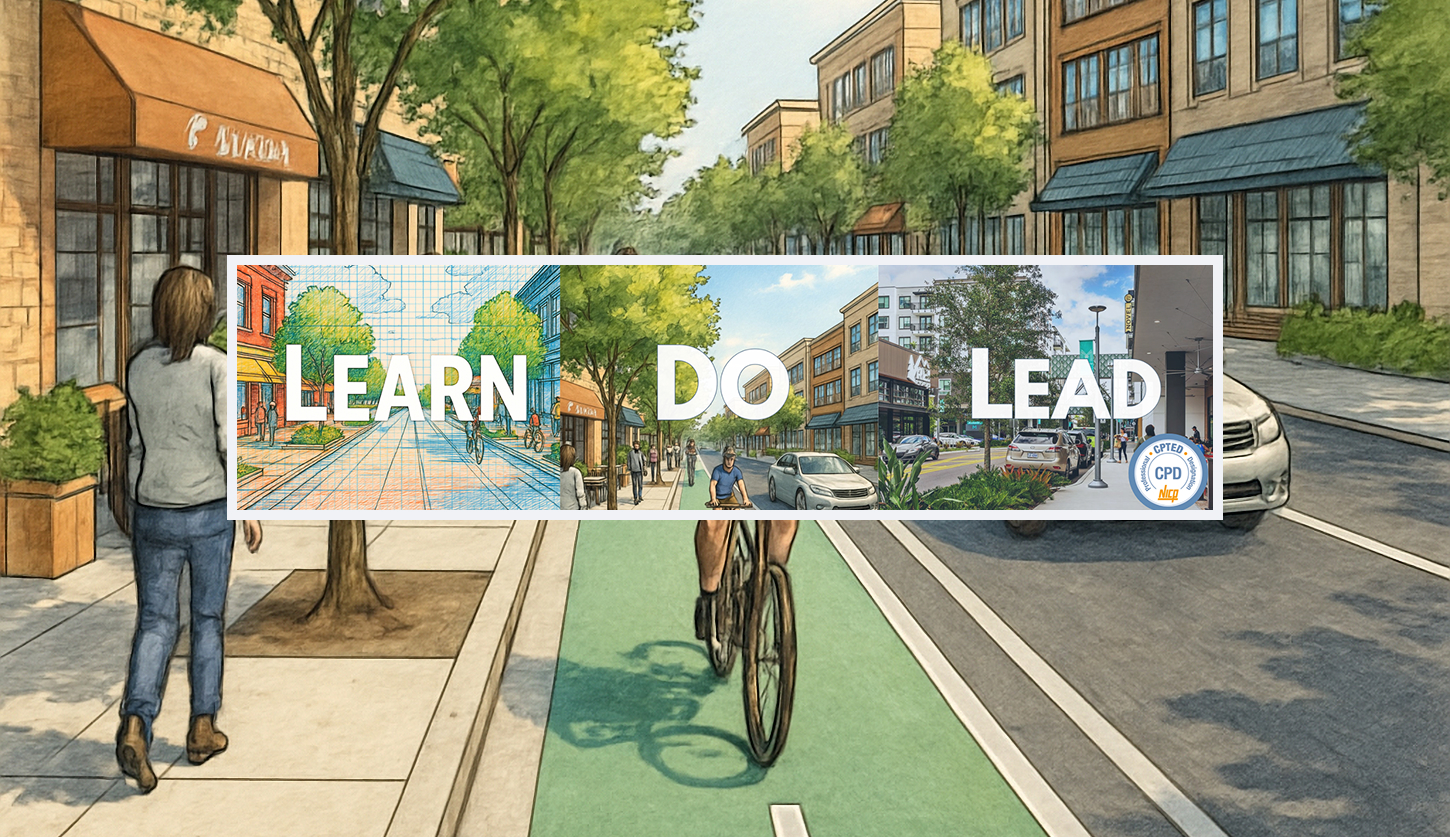

Learn. Do. Lead. — The CPTED Journey of Real-World Impact
By Joelle Hushen – President and CEO

Learn. Do. Lead. — The CPTED Journey of Real-World Impact
At the National Institute of Crime Prevention (NICP), we often say that CPTED isn’t just a professional discipline, it’s a way of seeing the world differently.
Every NICP course, project, and partnership begins with one simple truth: creating safer environments starts with learning, grows through doing, and endures through leading.
LEARN — Building the Foundation
The journey begins with learning the why and how of Crime Prevention Through Environmental Design.
In NICP’s Basic and Advanced CPTED programs, participants explore how the built environment influences human behavior—why lighting patterns matter, how sightlines shape perceptions of safety, and how thoughtful design choices foster trust, belonging, and natural surveillance.
Learning CPTED isn’t just memorizing four principles. It’s discovering a framework that empowers you to look at spaces—and communities—with new eyes.
Our students come from policing, planning, architecture, health, and education. What unites them is a curiosity about what makes places feel safe, welcoming, and functional.
Through immersive case studies, hands-on field exercises, and mentorship from experienced practitioners, participants begin to translate theory into insight. They leave with practical skills they can use immediately and the confidence to start meaningful conversations back home.
DO — Turning Knowledge into Action
CPTED becomes powerful when it leaves the classroom and enters the community.
The second step—Do—is where learning meets lived experience.
Graduates return to their neighborhoods, campuses, and organizations ready to assess conditions, collaborate with stakeholders, and redesign spaces to reduce risk and build connection.
They identify areas where lighting, access, maintenance, or territorial cues can transform behavior. They use their training to make parks feel safer, businesses more inviting, and public corridors more vibrant.
Every small improvement—each new conversation about safety and place—adds up.
When CPTED is done well, it doesn’t just prevent crime; it strengthens relationships, improves perceptions of safety, and renews community pride.
At NICP, we love hearing how our alumni take what they’ve learned and do something with it—whether it’s advising on redevelopment projects, shaping school safety plans, or guiding neighborhood revitalization efforts. Each project becomes a new example of CPTED in action.
LEAD — Inspiring Change Beyond Your Own Project
The final step, Lead, is where experience turns into influence.
Once you’ve seen CPTED work, it’s natural to want to expand its reach—within your organization, city, or professional network.
Leadership in CPTED doesn’t always mean a title; it means taking initiative.
It might look like creating a departmental CPTED policy, developing internal checklists for plan reviews, or building a cross-disciplinary CPTED team that includes planners, law enforcement, and community members.
For others, it means working toward codifying CPTED principles in local ordinances or design standards—helping safety and community well-being become part of the planning process from the start.
NICP’s Certified CPTED Practitioner (CPD) Program was built to support this stage of the journey. It recognizes professionals who are not only trained, but who are leading through applied projects, mentorship, and continued learning.
A Continuous Journey
“Learn. Do. Lead.” isn’t a checklist—it’s a cycle.
Even the most experienced CPTED professionals keep learning, keep doing, and keep leading. Each project reveals new insights, each collaboration broadens perspective, and each success story strengthens the profession.
At NICP, our mission has always been to help practitioners build that momentum—supporting them from their first CPTED class to the day they’re shaping policy and mentoring others.
Whether you’re just discovering CPTED or already guiding your community toward safer design, remember that leadership begins with learning—and every action you take can inspire someone else to do the same.
Learn from the best. Do the work. Lead the change. That’s the NICP way.

Joelle Hushen – President and CEO
Joelle Hushen is the Founder and President of the National Institute of Crime Prevention (NICP), Inc., an internationally recognized leader in Crime Prevention Through Environmental Design (CPTED) training and certification. Under her leadership, NICP has trained thousands of practitioners across law enforcement, planning, design, security, corporate, healthcare, and community development sectors, advancing CPTED as a practical, principle-based approach to creating safer environments. She has guided the development of NICP’s curriculum, assessment standards, and the CPTED Professional Designation (CPD), one of the most widely recognized CPTED credentials in the United States and internationally.
Joelle is also the Co-Founder and Director of the U.S. CPTED Association (USCA), where she supports national collaboration, professional development, and industry advancement. Her work focuses on the relationship between environment, behavior, and human experience, including the development of frameworks such as Embodied CPTED™ and Design for Decommission™. She is committed to expanding CPTED education and supporting professionals working to create safer, stronger communities.
Ready to Earn Your CPTED Certification?
Take the next step toward becoming a CPTED professional. Our in-person and online training options will prepare you to assess environments, apply proven CPTED strategies, and earn your CPD designation. Learn how to design safer, more livable spaces that strengthen communities and reduce crime before it happens.